Showing posts with label nature research. Show all posts

Thursday, June 11, 2015

The Saving of Insignificant Lives

This post is too somber for actual music. I chose a gorgeous soundscape instead, one of my favorites.

Fortune Soul, by Blackmill

---

Four weeks ago, I euthanized a male mallard duck.

Or at least, I was an assistant in his death; I was the one who held him down so he didn't make the process any harder than it had to be.

I was told it was completely painless, that the central nervous system was the first to shut down so he wouldn't be aware of his heart stopping, that to live with a calcified wing joint would be much worse than death.

I took his death well, I believe. It wasn't even like I was trying to hide emotion in the face of a (then) stranger. I genuinely felt no pity for the poor duck. I accepted his fate, that if he were to be released he would die anyways. In fact, I almost think I caught myself faking a little sadness for the staff member's sake; I didn't want to appear a complete robot.

But a week later, a fellow intern and I assisted in the euthanization of a crow with a severe concussion. We could literally see him drifting in and out of consciousness, and he was unable to sit upright or hold his head up. It was a lost cause, so the staff got the Fatal +* ready. But at the point of injection, I noticed the other intern beginning to cry. The staff noticed too, and comforted her. She recomposed herself after we left intake. We had other animals to care for. She didn't have time to cry.

*Fatal + is the name for the anesthesia we administer. It's very similar to anesthesia used for humans, but we basically overdose the animal so they never recover from unconsciousness. As a person who experienced anesthesia during the extraction of my wisdom teeth, I can assure anyone with concerns that it really is completely painless. I remember lying down on the surgery table, and ten minutes later they told me I could get up. I was never even aware I went under.

Am I really that insensitive? Am I supposed to feel such overwhelming emotion for an animal I have just seen? Am I, in fact, completely heartless? I understand the staff showing no emotion; they have been doing this for years. I have just entered this world and, apparently, with such a cruel mindset as well.

I have since witnessed eight deaths to date in six weeks, out of the roughly 10 deaths daily (not counting those who die on their own in our care). I've seen more raw illness and injury in a little over one month than I have in my entire life.

I am an intern at a very well known animal rehabilitation center, which is most know for taking in stray or abandoned dogs, cats, and exotics to adopt out. But in this particular branch, we have an amazing, brand new wildlife rehab facility, where we mostly get birds - passerines (songbirds), hawks, corvids, and waterfowl - but also mammals, like raccoons, skunks, and the occasional weasel.

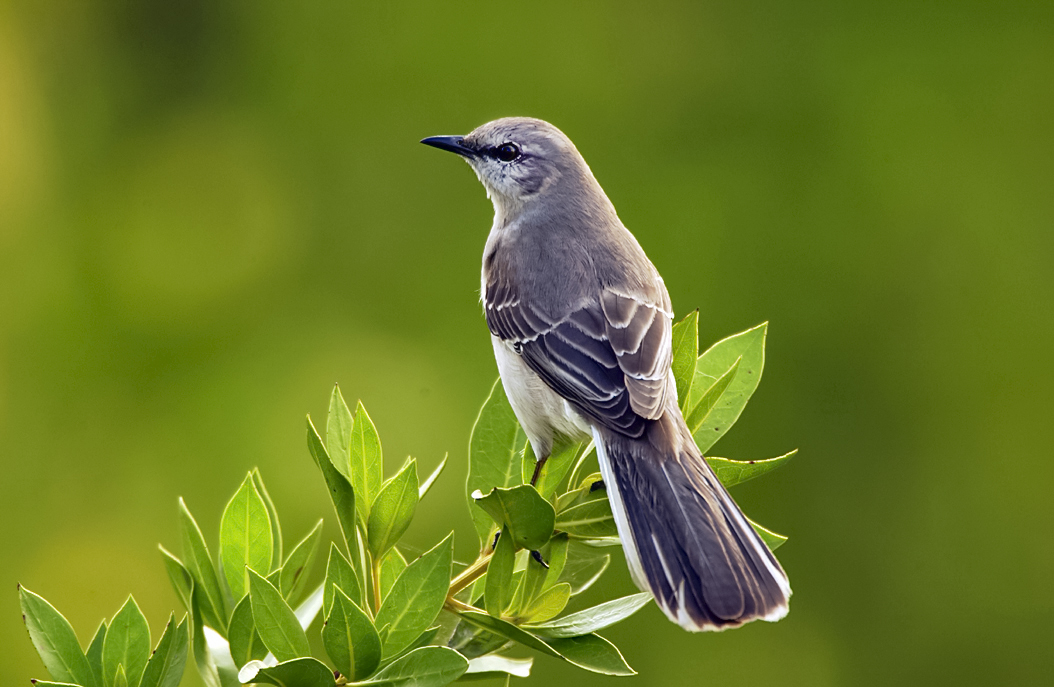
There are three areas: Recovery, Nursery, and Courtyard. Recovery is where we intake animals. People either bring them to us, or we get them from other facilities that don't treat wildlife. Mammals, seabirds/waterfowl, and large birds stay here to recover. Other than the actual treatment in the exam room, the stories that come with the animals are the most interesting. We've had a crow come in that was wrestled away from a homeless man (who demanded $480 as compensation for what he spent on it), a squirrel that was fed breast milk by the family that brought it in (apparently they wanted to get it back as a pet when we were done - the mere thought makes me cringe. There was also more breast milk in a dish with the squirrel...), a perfectly healthy raven who was only brought in because he refused to move off a man's motorcycle, and a mockingbird who's papers mislabeled it as an albatross.

Here is a mockingbird:


Here is an albatross:

How did they even make that mistake?

Nursery is where the passerines are kept, and sometimes squirrels if they can't be outside yet. I am not a bird person, but I have learned the different species just by walking around and reading the placard attached to each reptarium. Off the top of my head, I can say the most common birds we get are European starlings, juncos, finches, mockingbirds, robins, hummingbirds, scrub jays, sparrows (of multiple species - house, white crowned, golden crowned), rock pigeons, morning doves, and Brewer's blackbirds (abbreviated as BRBL, so we also call them burbles - so cute).

Courtyard is where we transition animals in Recovery and Nursery to outdoors. There are four aviaries for both passerines and squirrels, all decorated with potted trees and branches and hanging sticks - as close to the real thing as we can get. We also have a small garden where we grow chard and a variety of kales, to feed the pigeons, doves, and waterfowl. Also in courtyard are large raptor aviaries, where there are sometimes hawks, owls, ravens, and crows. There are also small and large enclosures for the mammals. In addition to all this, we have two large pools, labeled Seabird and Waterfowl, as well as two small treatment baths, to test for waterproofing.

Out of all of this, Nursery used to be my favorite. When I just started, I felt very self-concious whenever there wasn't any work to be done. Nursery takes care of that problem, because there is always work to be done. We have four feeding timers - 30 min., 45 min., 1 and 2 hours - and they are constantly going off. There are always birds to feed who can't feed themselves. However, now that I am much more comfortable with the people who work here, I have to say I agree with a lot of the other interns thus far - Recovery is the best. As one woman said (the one who cried), everything else - the courtyard cleaning, the nursery feedings, the baby raccoon terrors - hell, the entire internship - all of it is just a ticket into the exam room. There's nothing I like better than getting a new box without knowing what's in it, taking the animal out, and figuring out what's wrong with it and what to do with it.

Sometimes, of course, there's nothing we can do with it. Sometimes a well-meaning person brings in an animal that is too far gone, or they "saved" it from a predator, and we can't do anything but bring it it's inevitable end. Just this Tuesday, we got in a juvenile red-tailed hawk with trichomoniasis. While it's treatable, the bird had too severe a case, and it was so malnourished there wasn't much hope. After it was euthanized, another intern took some pictures of the case and emailed them to me. Here are a couple:


Notice the black at the back of the throat? Those aren't just shadows. Those are pretty advanced lesions, caused by the parasite. Lesions are usually cream-colored, and can grow big enough to block the esophagus and eventually suffocate the bird. This hawk's esophagus was covered with the stuff, and about half of its tongue, too. Also, the outer, upper part of its beak, which is supposed to be yellowish, was a sick greenish tone.

Here's a spread shot of the hawk, with me holding it:


I didn't do a very good job. The wings are much wider; the joint between the radius/ulna and metacarpals could've been extended a lot more. Interesting how they have the exact same names as our bones? Evolution ftw.

You can't really tell from the picture, but the bird was so emaciated you could feel its keel. That's the "breastbone" of a bird, it's nearly equivalent to our sternum but very wide and very flat. In a healthy bird, you should just barely be able to feel it. In this case, you could actually pinch it. There was no muscle whatsoever.

Keel:
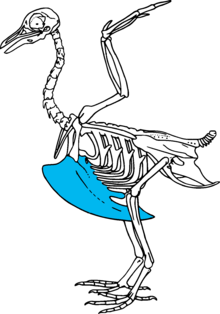
This wasn't some common mallard or crow. This was a hawk, of possibly the best-know species in California. And yet, I felt no more sadness at its death than I did the others. While I am uncomfortable and unnerved by my lack of extreme sympathy, I do much prefer it to crying in front of other people. I can cry by myself, easy. I have much to pity myself with. Being so vulnerable in front of other people, no matter how close I am to them, is another story entirely.

This doesn't mean I don't feel sadness entirely in intake. I'm physically conscious of my body slouching a bit every time I see the Fatal + bottle, but after thinking about it, I realize I just have a habit of accepting things very readily. For instance, if there's some sort of problem that could've been avoided by doing so and so - I don't even think that. The problem happened, and the next thing to do is to immediately alleviate said problem. I don't waste my time dwelling too much on what (unrealistically) could be done. I've transferred this habit to the exam room. The bird is sick. It will not recover, regardless of what we can do. I won't cause myself any more distress by dwelling on its mortality. It is hardly the first, and it will hardly be the last. Instead, I'd rather feel joy when working on an animal that does have a chance to recover.

As Dumbledore says, "Death is not the worst fate that can befall someone."

Tuesday, December 2, 2014

Survivor's Log 3

I'm in a tronpop mood tonight.

Love Like Woe, by The Ready Set:

---

(EDIT**: I uploaded this late, and it's now Dec. 2. My bad.)

I have one of those large calendars that you can write on, and tear off the months as they go by. 15 seconds ago, I tore off November and looked at the month of December.

Is my freshman year of college really already halfway over?

I only have three more weeks before winter break. Wow.

It feels like it's going to go by really quickly too. I don't have any more major projects to do, so all I have to focus on now is studying for finals. Lucky me, they're all crammed into the last two days of finals week (two per day), so I get to have maybe 30 minutes between one final and the next.

Sociology is as good as ever. In today's lecture the professor was talking about demographics and population, and I had a very long and passionate argument in my head as for why overpopulation and unsustainability is a thing. I had once read a comment somewhere (I forget where, it might've been on iFunny) that basically stated that the world isn't even close to being overpopulated, because we could pick up every person that exists and put them in Texas, with a sizable plot of land for everyone.

The lecture triggered this memory, and I had fun for 15 or so minutes asking this imaginary person how they could explain the placement of schools and buildings and agricultural fields in Texas as well, and telling them how selfish they are in continuing an unsustainable lifestyle with no repercussions in their life, but with consequences that the next generation must clean up. For Christ's sake, we only have about 250 years of coal left in the U.S., and that's not accounting for any surefire coal production increases (I apologize if that stat is wrong, I only parrot what I learned in AP Environmental Science).  And once that's gone, they will go on to tearing up new plots of land elsewhere until the entire Earth is scarred from fossil fuel mining. Anyways, while I had a good time mentally abusing this anonymous commenter, I lost track of what my professor was saying for a while. Oops.

Biology is boring. I'm kicking myself because my alarm woke me up at the right time this morning, but I was so tired (mild case of insomnia last night) I turned it off and instantly fell asleep right after. When I woke up again, class had already started. Oops again.

The professor is awesome though, nearly as awesome as my sociology professor and TA. He looks like Bob Ross (and makes fun of himself for it - I admire anyone who happily pokes fun at themselves) and has this thing called "Random Cat Friday," where in the middle of his slides there's a randomly inserted picture of a cat/kitten photoshopped in badass backgrounds (in space, or on top of a unicorn, for example). He makes lectures less boring, but the subject - pthbthhhh.

Chemistry is still a reiteration of everything sophomore year. A.k.a, boring. I forgot about the online homework, so I just finished it all during lecture, while occasionally looking up to pay attention. The professor, while being really sweet and likable, is not very good at getting to the point - one of my pet peeves.

Dance is the same as ever too. We've got nothing to do but work on our final project, which is to choreograph a dance that represents our cumulative semester. For a class that hardly ever danced, I don't think it's fair to have a final based on physical dancing, but I convinced my group to let me play the piano (Here I Am, by Bryan Adams from the movie Spirit) for a part of our choreography, so I'm moderately okay.

The professor is also warming up to my writing; I got a paper back today and even though I wrote it no differently than the papers that got B's, I got full credit. Go figure.

For a first college semester, I could stand to be more impressed. The majority of my classes are less than inspiring, and the students here - even more so. Emotionally, I'm constantly swinging between overjoyed radiance (like when I bumped into a friend outside of class - I don't have enough friends to do this even remotely often so it was a nice surprise) and flat-out depression (like when I realized I don't have enough friends to bump into on a daily basis). I mean, I'm not unwell. But I've definitely felt better.

---

I've been burning though a lot of songs as of late, so here's another one.

A Love Like War (feat. Vic Fuentes), by All Time Low


---

I haven't explored a new animal in a long time, so I figured since I didn't write too much I'll go ahead and find a new one to research.

Piure (Pyura chilensis)


I swear it's alive, even though it looks like the deadest thing in the world. Looks like hardened magma, that's what I think. Or a tomato encased in concrete. I'm just going to call it living rock; piure is the Spanish word for it.

This sea creature is a tunicate, or a marine invertebrate, and is completely immobile. As you can see in the picture, it resembles a rock with a bunch of organs inside. It eats by sucking in water and filtering out microorganisms, and lives in close bunches with other living rocks (imagine a mussel bed). This weird... thing is born male, becomes a hermaphrodite during puberty, and can procreate by self-fertilization (O_O). I found an article that calls it selfing, and that's the only way I will ever refer to asexual reproduction from here on out. Basically, it reproduces by squirting out its joy juice into the water in a giant orgy cloud, and hopes it runs into some gametes of the opposite gender. Too far?

It's mainly found off the coast of Chile and Peru, and the two largest importers of living rocks are Sweden and Japan.

It's perfectly edible, and can be eaten either raw or cooked. Apparently it tastes like iodine - a slightly bitter and soapy taste. However, there are some concerns about eating it, because its clear blood contains high amounts of vanadium (a chemical element) and can cause damage to the liver if eaten in excess amounts. For context, vanadium is also found in crude oil and tar sands. 

Actually, however, parsley also has trace amounts of vanadium too - that's why it's used as a garnish so often, the flavor's pretty strong. So if you're ever short on parsley, add a bit of selfing vanadium-secreting intestine-tomato-rock thing to round out your dish.

Take my word for it. I'm a great cook.

Saturday, February 8, 2014

#deep

I might stop my every-Friday-write-a-post thing. I think of all these cool topics to write about during the week, then forget them when I sit down to write. I might just write on whatever day, whenever I think of anything, while it's still fresh in my head.

In other words, I have absolutely no idea what to reflect on, other than I know there's been a severe drought this winter, but the amount of rain we're getting now is ridiculous.


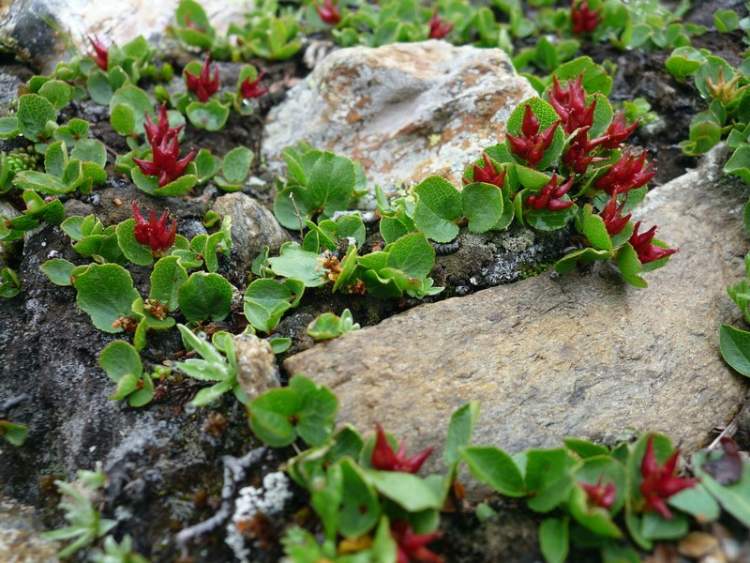
Dwarf willow (Salix herbacea)


You might've guessed from the name of this plant that it's actually a tree. The dwarf willow is the smallest tree in the world, and one of the smallest woody plants out there. The reason for its size is the factors of its habitat: it lives in freezing alpine and arctic environments. If you want to research further, you'd be hard pressed to find a plant up there in the north much bigger than this. And I'm not forgetting the actual pines up there, I mean finding large plants in the wind-swept tundras and moorlands. Its leaves are round, green and about the length of 1 cm. The dwarf willow has female and male catskins, which means it's appearance varies. It can be yellowish (male) or red (female). Based on this, I conclude that the willow above is female. I'm a botanist!

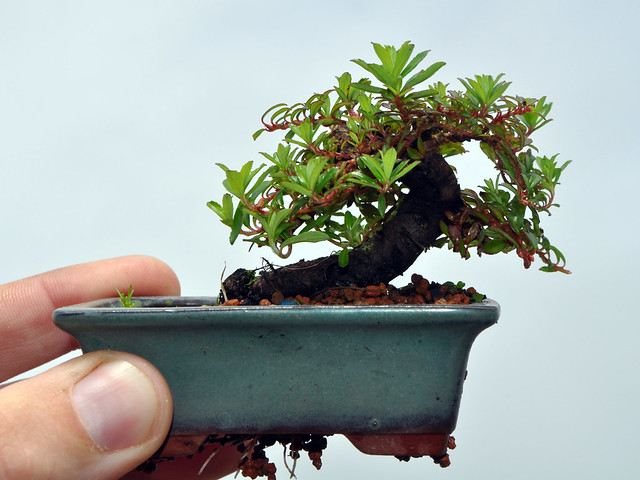
They're mostly found on both sides of the northern Atlantic region, including Greenland, Canada, Northwest Asia, and in the northern ranges of the Appalachian Mountains. It grows in ranges about 1,500 m altitude and over, but that doesn't stop people from bringing it down closer to sea level. The dwarf willow is a popular choice for advanced bonsai growers, due to their delicate frame, size, and the color of their buds. Exhibit A:


Just kidding, no more exhibits, I had a really nice picture of an even smaller bonsai willow, but I can't find it again. Curses.

Fun Facts:
  • It's the only type of tree that grows in the tundra.
  • It can only grow up to a maximum of 10 cm: About the length of an average human's palm. However, they average to about 5 cm, but can spread itself out quite a bit.
  • Its other names include snowed willow and least willow.
  • Texts from Sumer, Egypt, and Assyria that the bark and leaves of the willow tree can be used to cure aches and fevers. I don't think they meant this specific willow. Whatever. Still interesting.
  • The Ancient Greeks also believed this.
  • So did the Native Americans.
  • It should be noted that not all people accept the dwarf willow as the smallest tree. Some say it doesn't qualify, and that it's actually a small shrub.

Friday, January 31, 2014

Elementary, My Dear

I am a little ashamed to admit that I haven't bothered to clean out my bookshelves since I was around 13. This means most of my childhood companions are still on the shelf - The Penderwick Sisters, Roll of Thunder, Hear My Cry, White Ruff, The Trumpet of the Swan, Chasing Vermeer - all along those lines. I can't visit the library as often as I like, which means I frequently revisit these bookshelves. The stories are still as good as I remember, and there are constantly little bits that I read that I don't remember reading the first time. That's one of the best parts of rereading, right? You get to find new sentences you skimmed over last time. I still find new parts in my Harry Potter books, and I've thoroughly canvassed those. Thoroughly.

And yet, while most of them present unchallenging topics, I pulled from my shelf two days ago a book that was surprisingly advanced for its book cover and length. Super surprising, because this is one of those that I've reread many times - maybe five or six times? - and I've never picked up on so many subtle themes before. Is it my age? Am I finally "mature?" I can't believe that was the reason - I remember thinking nearly the same as I do today as I did back when I was thirteen, and yet even I can't help feeling a little condescension towards those in their early double-digits.

But I digress.

This book is called The Shadow Guests, by Joan Aiken. The last time I read it was, oh, maybe two years ago? Back when I was still a sophomore. The basic plot (I'm trying so hard not to spoil) is that Cosmo Curtoys (pronounced 'Curtis' - Cosmo's a stickler about that) moves from Australia to England to stay with his Cousin Eunice, a mathematician. While there, odd occurrences happen and he discovers that he is part of a family that has a curse upon it, one that dates back to when the Romans began taking over what is now the U.K.

A pretty typical plot, very predictable, but that's not why I've brought it to light. Concentrated in the middle of the book are a lot of theories about mathematics, space, time, that sort of thing. Here, have a quote:

"I began to wonder why their maths was getting better and better but also wilder and wilder - they seemed to be grasping concepts that I'd have thought were far out of their reach; and then I went out to dinner with the local Laird and his family, and when I got back the students and the whiskey runners were having a great party, playing sardines all over the castle and hunting in the dungeons for the square root of minus one, which somebody swore he had seen down there." 


It's not just the students grasping at concepts. Aiken mentions quite a few; I dogeared the pages that stood out the most to me. A lot are about bending time and space. It's along the lines of looking at stars as they were millions of years ago, and if there were living organisms on those stars/in those solar systems, they would look on Earth and see the volcanoes covering the surface, or the ocean forming for the first time, or maybe even the first of the Australopithecus. In short, concepts I skimmed over when I was younger.

"Can we affect what happens in other dimensions? Or can those happenings affect us?... I honestly don't see why not... After all, even if you just see a thing, it can affect you in all kinds of ways... Seeing a film can change your life. And if the sight of a thing can do that to you, then the sight of you can affect it. There's a theory, you know, that no experiment can be wholly detached and scientific if somebody is observing it. 'Dear sir, it is not at all odd/ I am always about in the quad,/ And that's why the tree,/ Still continues to be,/ In the sight of,/ Yours faithfully, God!' " 


Seeing a film, yes, that can change your life, but can you change the life of the film? Not likely, unless it was by your approval that it was hugely popular or your condescension that lowered the net gain of the company. So, you can change an inanimate object's life, but I don't believe the pure sight of you changes them. Not directly, of course. I suppose I see the reasoning behind the theory mentioned - as long as someone is putting on the pressure to do well, there will always be a bias. Doesn't mean I agree with it. I further researched that interesting phrase and found this page. By reading this I realized it's a limerick. Much more sense. Of course, this theory is only valid when it is given that God is real. Wait, no, there's always something somewhere. They make it seem that everything's under observation by God, but if you count beings that aren't sentient (like the film) then we are always under observation by those things too. No need for God.

"I chose to go off into the desert because I didn't choose to die in some stupid war... Wars are an outdated way of settling problems."


Why doesn't everyone else understand this? This has been my mentality since nearly forever; I remember my 8th grade English teacher showing all the boys in my class a form they had to fill out in case the Army et al ever recruited them when they were older, and thinking, I'm glad I don't have to ever be forced to go to war. This is one gender stereotype I'm moderately okay with.

Don't get me wrong, I 97.6% (there are always some people with questionable morals who enjoy it) support those that go to war to shield and defend their families, and even especially those who are drafted into a war where they aren't defending anyone, but forced to by higher powers. I've heard of the ways some people who don't support a war (mainly the Vietnam War) treat those that were a part of it. No matter the reason the war was fought, those soldiers still put their lives out on the line. It is inexcusable behavior to treat them with disrespect and contempt. The majority probably didn't even want to go into battle.

This being said, I still think there shouldn't be wars at all. Alas, I probably won't live to see those days, if they ever do come.

" 'How do you suppose that circles differ from triangles?'
  'Well, sir: triangles are all different from each other. But circles are all the same. You could put them all inside each other and they'd fit.'"


One of those things that are so blatantly obvious and yet is still somewhat of a mind-blower when you realize it.


" 'Ain't she smashing with her hair done so posh,' said Mrs. Tydings fondly, and Cosmo noticed that Eunice had her hair drawn up in a great silver-yellow sweep and looked quite like a model of a film actress - not in the least like a possible Nobel-prize winner."


Perhaps it's the feminist within me that cries out that it is unjust to think that a woman can be either smart or beautiful, but not both. I'm a little put off by that voice; to me it's whiny. Ah well.


Eunice had told Cosmo about ogham: It seemed a very useful and beautifully simple writing system, twenty different combinations of straight lines meeting each other; what a pity it was no longer used.


Here's everything: link. I wouldn't call it beautiful, but it is quite interesting. 


" 'Teach you? Wh-what am I supposed to teach you? Geometry - stuff like that?'
   ' Nay, no magic. I am a very plain fellow.' "


To think that geometry and simple maths used to be thought of as magical. If the twelfth century could see our age now. Or if we could see the thirtieth. 

All this and more in a book aimed at middle schoolers. And here I am, a high schooler about to go off to college,  learning new advanced maths in it.

Maned Wolf (Chrysocyon brachyurus)


How gorgeous is this thing? Deer-wolf!

It's been a while since I researched an animal/plant, so I want to resume with this guy. I can't stop looking at dem legs.

They aren't very big, only about 3 feet at the shoulder and 50 lbs. Theirs ears are quite long, about 7 inches, presumably to catch even the smallest sound. They have a reddish-brown coat with black points (muzzle, legs, ears - they're called points on a bay horse (as well as other colors), I took some liberties with transferring the usage). Their throats and the tip of their tails are white. The long fur on the back of their necks can stand on end, giving the appearance of a "mane." They live in Central and Southeastern Brazil, Paraguay, eastern Bolivia, and northern Argentina, in the open forests, savannas, and marshlands. They are omnivorous, eating small mammals, insects, reptiles, birds, bird eggs, fruits, and vegetation.

They're not completely endangered, per se, but they're a bit too close to the line for comfort. They don't have many natural predators, but need lots of open space to claim as territory. This necessity proves to be their undoing, as habitat destruction is spreading over their homes.

Fun Facts:
  • They can tap the ground with a front foot to flush out the prey so they can then pounce on it. 
  • Maned wolves are monogomous. Though males and females generally live solitary lives and come together only during  breeding season, they share defended territories. 
  • The maned wolf is the only species in its genus.
  • The maned wolf’s fox-like characteristics – the shaggy, white tipped tail and large ears – have earned it the nickname of “fox on stilts.” ACCURATE.
  • They like bananas, apples, and avocados.
  • Many are hunted because it is believed, in some parts of the world (probably Asia), that specific body parts contain magical healing properties. Gee, where have we heard that before? The magical western black rhinoceros, with it's all powerful "cancer-healing" horn, was declared extinct on November 6th, 2013 due to excessive poaching. The last one was seen in 2006. Seriously though! People are basically eating placebos made of ground fingernails!
Enough depression.

This song seems accurate for this post: What's My Age Again?, by Blink-182

Tuesday, December 31, 2013

Rising Part 2

Apologies for the late post - I was too busy enjoying a view of the BIGGEST. TREES. ON. EARTH. in Sequoia National Park. Of course, with great enjoyment comes great sacrifice - I had no service or WiFi for four days.

I realize that I should finish my no-plot/no-effort/no-idea-umm-what's-going-on-guys story I started last time. It was all just an excuse to write down a cool setting and a half-hearted attempt to add plot to it.

I'm lazy. Sue me.

---

Yes, a cliff. A cliff roughly 200 feet in the air to where it met the lip of my cave, and then extended about 100 feet more above me. It was a long one-way trip to the craggy rocks the sea washed, but I had conquered my fears a long time ago. I considered myself a very rational person, and told myself I did not have a fear of heights, just a fear of falling, and time had acclimated my senses to my airy loft.

Of course, I couldn't hide away in my cave all the time. I would surely starve. The same man who helped me with my doorway curtain had built and hung a sturdy wooden platform outside the opening of the cave that I could step on. A pulley system allowed me to  lift the platform up to the top of the cliff. When it was first built, a rail had stood on the two widths and the length farthest from me, enclosing me on three sides and leaving the cliff wall to be my fourth rail, but a strong wind had blown up from the sea a couple of months ago and smashed my platform into the cliff. Luckily, I wasn't on it at the time, but the rails had broken off and I hadn't the skill needed to repair them. I reassured myself with a doubly strong grip on the ropes and continued using it.

I reached out and pulled the ropes to me, my toes still clutching the rim. The platform swung a bit as I stepped on, but I had come to enjoy the vertigo of the sheer cliffside. It was a short fifteen seconds to the top, and when the platform stopped just below the top of the cliff I had to haul myself over the edge.

By this time the sun was a good ways above the horizon and the birds were out in full force. I stood up and surveyed the flat green plains that stretched for miles in each direction. There was a small town to the east, but I avoided it whenever I could. I didn't like the stares the women there gave me, muttering about properness and civilization.

I pitied the people in the cities. There was no quiet, no privacy, no breathing room. This place was all mine. I breathed in a deep lungful of air, exhaled, and watched the smoke dissolve into the rising sun.

---

I'm bored. So much for that.

Since I spent so much time at the national park, instead of researching a cool animal/plant I'm going to regurgitate everything I can remember about Giant Sequoias from reading/learning from the park rangers.
  • What I think the Latin name is: Sequoia sempivirens giganticus. What it really is: Sequoiadendron giganteum. Ah well.
  • The biggest living tree IN THE WORLD is General Sherman (biggest meaning volume, not height). It's about 2,100 years old? Idk, you'll have to check that yourself. The person who discovered it named it after Sherman of the Civil War because he had served under him. However, some other socialists bought the land it was on and wanted to call it the Karl Marx Tree. In the end, since this is 'Murica, the park people went with General Sherman.
  • The seeds look like flakes of oats. 
  • Fire is necessary for sequoia growth, as the heat rises up and makes the cones open and drop their seeds, as well as killing harmful insects and fungi and clearing away the duff on the forest floor so the new seedlings don't have to compete with dead debris.
  • The third largest tree IN THE WORLD is the General Grant (Ulysses S.) Tree. This baby is the National Christmas Tree, in case you were wondering, and also a national monument in honor of the US soldiers.
  • Their bark contains tannin, the same as redwood, which is fireproof and mostly bug/fungi proof. However, unlike their redwood cousins, sequoias have soft heartwood, making them less than ideal lumber choices. This is why so many of them were eventually saved - because people couldn't make money off them.
  • The National Park Service badge/insignia -
                          

    has a sequoia on it as that tall tree because 3 of the first 4 National Parks were created to protect sequoia trees.
  •  The Centennial Tree was cut down in 9 days by two men (I think, I get all the days mixed up, there was another that took 13 days) in the 1800s, cross cut and cut even more into smaller pieces for shipping, and shipped over to the East Coast to show them how big the trees were in California. Their reaction? They said it was a "California Hoax" and was assembled from many different trees.

Oh yeah, and I guess it's New Year's Day. Whoops. Happy New Year's!

Last thought: My grandma got me the book I Am Malala for Christmas, and I finished it last night. The book touched on a poem that really got to me.

     First they came for the communists,
     and I didn't speak out because I wasn't a communist.
     Then they came for the socialists,
     and I didn't speak out because I wasn't a socialist.
     Then they came for the trade unionists,
     and I didn't speak out because I wasn't a trade unionist.
     Then they came for the Jews,
     and I didn't speak out because I was not a Jew.
     Then they came for the Catholics, 
     and I didn't speak out because I was not a Catholic. 
     Then they came for me,
     and there was no one left to speak for me.
                          - Martin Niemöller

Niemöller had lived in Nazi Germany. Make of this scrap what you will.

See you next year.


***PUNNYPUNNYPUN SONG:*** 

The Final Countdown, by Europe

Saturday, December 14, 2013

Can't Look Up

What are the characteristics of a bad student?

1. Doesn't do/put effort into homework.
2. Doesn't show up to class.
3. Sleeps/dozes/daydreams during most of the day.
4. Refuses to study.
5. Procrastinates constantly.
6. Rude and distractingly loud.
7. Often refuses to follow/ignores directions.
8. Sasses the teacher and laughs about it afterwards.
9. Tries to pass off a missed deadline on a lame excuse.
10. Cheats off other students.

According to my list, I am 35% bad student. Nope, nope, nope, from what I remember of freshman year I was 15% bad student. My life has gone from average student to borderline SENIORZZZ mania. It's only a few more months before I start cutting class. Oh god, never never never. I can't believe I would even think that. What is senior year doing to my mind?

But in all seriousness, my academic life has taken a nosedive and reverse engines are failing to initiate. I'm praying that I make it through my finals. I'm praying I get into a good enough college. I'm praying I make it through my finals so I stay in a good enough college. Why do I feel so much pressure to get into a good school - and not just a good school, but a good one that people have heard of? You hear what everyone says, "just because they aren't as popular doesn't mean they're not as good." Well, yes, they can be acceptable, but the whole reason that you hear about good schools is because they produce good students, and you don't hear about the "good" schools because they don't produce as many.

I would count it as a failure on my behalf if I didn't get into a reasonably well known school, and instead got into some place out in the nowheres. When people ask me where I'm applying, I don't want to feel a sense of shame listing my schools that I applied to; I want to say a reputable name instead of having to tell people in which state a college is when they ask for my list. But I can't help it, I can't tell people the name of a high-ranking college without feeling like I was being judged, like they're thinking, "Wow, that's a reach for her. I wonder why she's shooting so high for a place that's obviously going to reject her." I wasn't good enough.

It's shameful feeling like I'm the person with the lowest intelligence level in my close, immediate group of friends. The best places judge you on your grades (which is the definition of intelligence level in this case), not so much your personality, interests, dedication, so forth. Sadly, to me, those grade-oriented ones are the only universities that count.

I want so much. I wish for the day where I can be genuinely happy in my first choice college. I wish that my closest friends will get into colleges/universities close to mine, or that we stay in close contact for many years. Or that we even end up with a happy ending.

Call me Miss Sunshine.

Welwitschia (Welwitschia mirabilis)
On a past post I put this as one of my favorite plants. Now you get to know why!

Take a good look at that picture. How many leaves do you see?

The answer is two.

It's generally accepted that it was named after the Austrian botanist Friedrich Welwitsch, who first documented it. An adult welwitschia consists solely of two leaves, a stem base and roots.  Its two permanent leaves are unique in the plant kingdom, because they are the original leaves from when the plant was a seedling, and they just continue to grow and are never shed. As you can see, they instead bundle up into a deceptive octopus mass. The two leaves are leathery, broad, and strap-shaped (I can't think of a better comparison word) and they lie in a heap on the ground. The leaves shred at the ends into length-wise strips, due to time/wind/etc., but it soon grows back The stem is low, woody, hollowed-out, and sturdy. It usually grows to about 500 mm in height. The welwitschia is endemic to the Kaokoveld Centre in Africa, spanning part of the coasts of Namibia and Angola.

Cool Facts:
  • Informal sources refer to it as a "living fossil."
  •  It is the only genus in the family Welwitschiaceae and order Welwitschiales.
  • This succulent plant (SUCCULENT KAROO, LOOK IT UP, IT'S AN ACTUAL PLACE) can live up to 1,500 years.
  • It's thought to be a relic from the Jurassic era. It hasn't changed much since.
I want a relaxing song tonight, since I have too much homework to stress over, so have the first Italian song I ever heard. I assume you ( the reader) speak English, so I found a video with English subtitles. If you are a native-speaker of Italian and are learning English, yay, practice! If you don't speak English at all but speak Italian, then that last phrase was completely redundant. Enjoy one of the best songs of your language.

Vivo Per Lei, by Andrea Bocelli (feat. Giorgia)


Saturday, December 7, 2013

Derailing from Track to Track

Winter is finally here! At least, as close as it gets to winter in California.

Senioritis has really hit me hard. Despite the fact that every single one of my classes are AP, I have no inclination to study or do the homework, as long as it's not due the next day. A lot of stuff gets piled up last minute, and sometimes I don't even finish all of that. I just turn it in partially finished, or find a way to make it look finished. I do feel bad about that - I've never been one to easily cheat. But I'm growing fed up with school. I've been continuously waking up much to early for too many years, studying hard for subjects I will never touch again in college, and putting up with the stress of confining myself into social acceptances, as every single teenager has done at least once in their lives. Yes, First World problems. For an angsty, angry teenager, that doesn't mean they're still not problems.

It's getting too cold to go back to Roost. As much as I love it, I love the warmth of my bed and my cup of hot chocolate better - especially when it's coupled with a good book. Lately I've started more books than I can finish. I checked out a book last week, and before I could finish it, checked out another one yesterday. This doesn't include the unfinished two from months ago, or my English Lit book Frankenstein, or the book I have yet to choose for my independent reading for school. OR the many others I have on my to-read shelf on Goodreads.

I never thought I would say it, but there are too many books in my life right now.

I also wish I had the motivation to continue a small side project story that I started with my best friend at the beginning of summer. It's wonderful to work on, but unless it's started right, I'll never have the energy to finish it. This has become blatantly obvious - I haven't touched that Google Doc in over a month now. I've always known about this flaw of mine, though. It happened whenever I was given a new piano piece to start on that I wasn't super enthusiastic about, and especially now in AP Studio Art, where we have to churn out top-quality work in a mere two weeks (when we are used to having two months to produce top quality work. What are stress?) I come up with an idea, but if it starts out looking funky, I give up almost immediately on fixing it and leave it lying around until the deadline the next day.

If I lay here, if I just lay here, would you lie with me, and just forget the world?
-Snow Patrol, Chasing Cars

*As I was re-reading my post, I realized how scattered the topics are, so that explains my title. It was taken from another one of my posts, I don't know which.

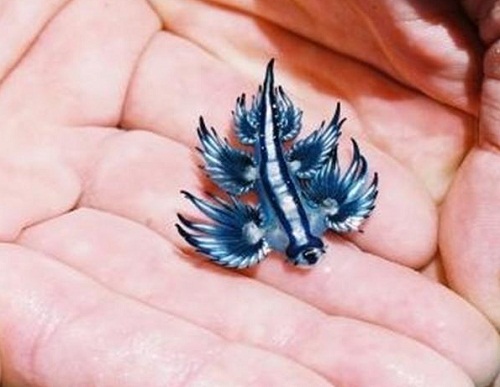
Glaucus Atlanticus (It has no commonly used common name)


If this is not the most beautiful thing you have seen today, then you need to tell me right now what was more beautiful (excluding your significant other/idol/pet/yourself).

Please, have another picture. Can I just show you a bunch of beautiful G. Atlanticus pictures and not list the facts?
Okok, I'm done.

The glaucus atlanticus is a species of sea slug. And as most sea slugs are, these are poisonous - a human picking one up may receive a very painful sting. How do you feel about the picture above now? There are also serrated teeth in those appendages. Talk about the thorn within the rose.

This nudibranch can grow up to 3 cm, and lives in temperate/tropical waters, mostly around the East and South Coast of South Africa, European waters, the east coast of Australia, and Mozambique. It preys on assorted sea snails and such, and the dangerous Portuguese Man o' War (it's ability to do so lies in it's concentrated venom, which is more powerful than the Man o' War's. Also, it's immune to the Man o' War's venom, and instead takes it in and saves it in sacs for its own usage). Occasionally, given the chance, g. atlanticuses are cannibals.

Cool Facts:
  • Due to it's unique feeding habits, the g. atlanticus cannot be bred or held in captivity without quickly killing it. 
  • Due to a gas-filled sac in its stomach, it floats upside down on the surface tension of the ocean.
  • Much like the great white shark, the g. atlanticus has counter shading, which means (since the g. atlanticus floats belly up) the stomach is a darker shade, to blend in with the ocean's surface from an aerial POV, and the back is lighter, to blend with the sunrays shooting down through the water.
  • The not-common-enough names include the sea swallow, blue angel, blue glaucus, blue dragon, blue sea slug and blue ocean slug.
 Because I was talking about not being grateful about my First World status, here's an appropriate song:

You, Me, and the Bourgeoise, by The Submarines


Friday, November 22, 2013

Functions and Allen Wrenches

This Sunday is my school's first robotics qualifier ever. We're all like dogs, happily on the way to the vet, before we get our dreams crushed when we see what awaits us - i.e., the competition.

Nay, I shall have faith until the very end, unless we actually qualify, in which case I say I knew we could do it all along.

...

This was a bad topic to choose to write about. Perhaps I will just edit it Sunday night to recap the events of the day.

Edit:

The competition was oh-so-slightly short of a disaster. The only thing keeping us from it was good spirit, a veteran engineer, and lots of medical tape.

Yes, medical tape.

We started out well enough at the event - we made sure our own robot was functioning (in retrospect, "functioning") and then we sauntered around looking at the rest of the robots. That's when we noticed ours was the only one with wooden parts, and a rope pully. Everyone else's were giant metal cubes in the design of war tanks, with elaborate devices and gears. 

It pretty much went as expected from there: our frail frame and misjudged program soon tipped the robot over, spooling the pulley and making it pretty much useless. We regrouped and fixed the robot, but didn't change anything about it - first mistake. I don't know why we didn't; I guess we didn't have time. Our first point was so funny - there was a revving up of "Ooooooo"s as our robot approached its target, then an outburst of wild cheering - all for a couple measly points. Watching the video, I now see how dorky and naive we were in the others' eyes. No one cheers like that at a robotics competition.

And then our robot broke.

One team member improvised a brilliant strategy: we used the first roll of tape we came across, which happened to be the event's medical tape, and created a very crude but effective scoring device. And yes, we won that round! Sadly, we didn't place high enough and didn't qualify at the very end.

 Oh well. Next time.

Hoatzin (Opisthocomus hoazin)

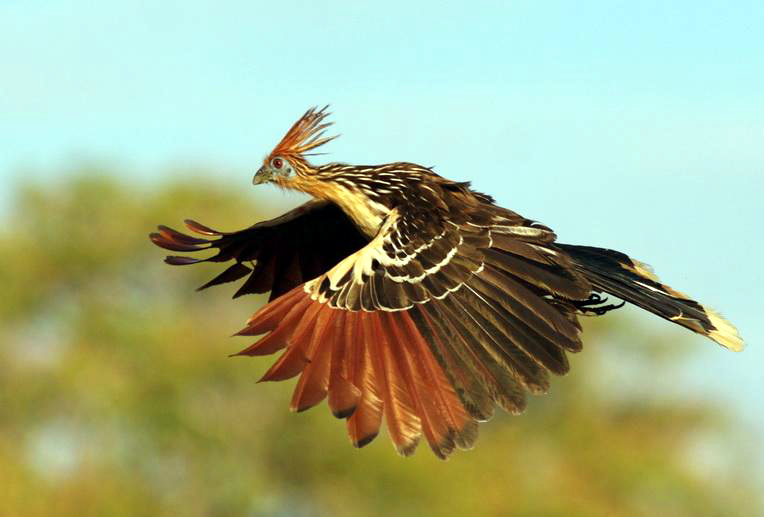
This bird is the only member of the genus Opisthocomus, which, in Ancient Greek, means, "wearing long hair behind." It's by itself because it doesn't have enough similar traits with other like birds. It's a tropical bird (not to be confused with the birds of paradise) that mainly populates the continent of South America, in the swampy, mangrove-y, riparian-y forests of the Amazon and the Orinoco delta.

Orinoco Flow, by Enya

They are roughly pheasant-sized, reaching about 25-26 inches in length and 1.8 pounds, with an unfeathered face of blue skin, topped by a rufous crest (now where have I heard that word before? Knowledge is awesome.) The rest of its body is a combination of black and russet-red, streaked with white along the neck and wings. The tail is composed of 10 loosely attached tail feathers. They breed in colonies, with usually 10-50 birds in just one. Their eggs are a creamy/beige white spotted with blue and violet splatters.

Cool Facts:
  • It's offspring are born with two claws on the tip of both wings, which it uses to crawl around. These claws fall off by the time they are juniors.
  • It's also known as the stinkbird, because of its unusual digestive system with an enlarged crop used for fermentation of vegetable matter.
  • Although it has completely developed wings, it rarely flies, because of its weak pectoral muscles.
  • They are exclusively herbivores.
  • If you thought they look and sound like the dinosaur Archaeopteryx, then I love you. Even so, scientists know they are not descendents because the hoatzin developed claws only to cling to trees hanging over water. 
  • In fact, scientists don't know when, how, or why the hoatzin evolved to be the way it is now. DNA sequencing projects are giving very mixed results.
  • The hoatzin is the national bird of Guyana.

“We all live under the same sky, but we don't all have the same horizon.”
-Konrad Adenauer

Friday, November 15, 2013

Roosting

Why can't college apps finish themselves? Can't we just dictate the most important facts of our lives to a microphone and be done in a few minutes? Why must they vary?

The season is stressing me out, and I need to relax. Finding a quiet area in a busy suburb town can be difficult, to say the least, but having a nearby canyon is pretty handy. 

Other than the occasional energy bar wrappers and crushed Arizona cans, Mills Canyon is like the drought-tolerant Central Park of Burlingame. I started going there at an early age with neighborhood friends, and when I fell out with them, continued to go there alone. Pretty soon, established trails started to bore me – I think at one point I could’ve walked some paths blindfolded – so I began to pick areas adjacent to the path that weren’t covered with poison oak and simply went wading through the dried foxtails. This year, I went off the path in a new place where I hadn't thought to go before. It was through this venture that I discovered what I call Roost.

Roost is a huge boulder, perhaps 15 feet tall and 20 feet in width, that lies at the bottom of the canyon, directly next to a small creek. It partially juts out over the water, creating a small pebbly cove where I hide whenever I hear people on the trail. A tall but skinny oak tree lies between Roost and a smaller boulder a few paces away; other than that, the surrounding ground is relatively clear of foliage. On Roost’s other side, an older, taller oak tree grows nearly flush to its side. All around this clearing, dark ivy covers the banks. Oak and bay trees are more densely clustered; their canopy filters the sunlight and casts dappled patterns on every surface. When I was younger, I would pretend the wind was alive and sentient. It would tell me of the places it had been, and whenever it rose from a gentle breeze to a strong gale, I believed it was I who, through some magical force, had controlled the change. I still do believe it, sometimes.

You cannot begin to imagine the feel of wind against your uplifted face and closed eyelids unless you have actually experienced it first-hand.

Of all my sanctuaries, it was Roost who taught me to breathe. I could relax atop it, secure in the knowledge that no one below could see me, and listen to the sounds around me. I could hold on to a thick branch of the adjacent oak tree and run my thumb over its rough bark – in concentrating solely on the texture of the branch, I could drive out all other unpleasant thoughts. It is my site of meditation, my eye of the hurricane, where I can doze and let my troubles leach out of me into the granite below. Without Roost, I don’t know how I would’ve stayed calm all those years. Maybe I wouldn’t have. The thought makes me appreciate all the more what Roost means to me. It will be hard to replace in the coming years.

I'm sure the site of a haven varies wildly for other people. They may find their place of contentment in a dusty library, or perhaps in a summer house. Maybe their peaceful environment is their backyard pool, or situated among the white noise of a large city. I, I climb the highest point I can find and let the wind breathe for me.

 Sensitive Plant (Mimosa pudica)


I came across this plant ages ago, when river tubing (Is that the name? We were using inner tubes) down a river in Puerto Vallarta in Mexico. The tour guide had pointed it out where it grew along the path, and invited us to touch the leaves. What would you expect to happen?

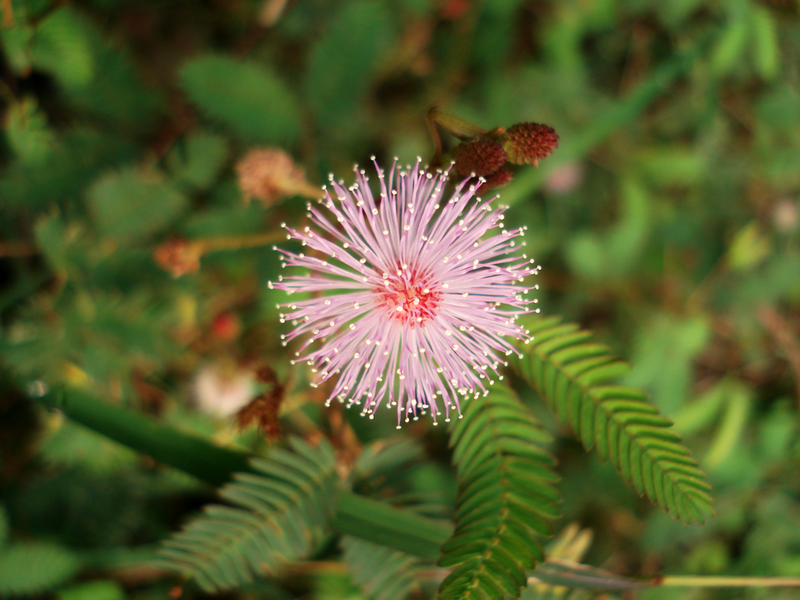
The sensitive plant has a most amazing defense mechanism: it withers and folds in on itself whenever it is touched, or otherwise warmed, blown upon, or shaken. They reopen minutes later (so you can touch them again and watch them fold... and again... and again... unconscious hypnosis). They also close during the night, and open again during the day. There are about 10-26 leaflets per pinna (leaf stem thingymajigger, I don't know. Context, man). Their seeds are contained in brown pods and are mainly pollinated by insects. They produce round flower heads that range from pink to pale lavender. Have a picture, I can't describe the shape: 

They are most commonly found in South and Central America

If you have taken Biology, hopefully you know what turgid means. If you don't, here's my best explanation: The reason plants are usually so crispy (think of the base of a romanian lettuce leaf) is because the spare space in their cells is filled with water. If our cells were like that, they would burst under pressure, but because of the strong cell walls that plant cells possess, they merely swell up but keep their shape. This is part of the reason why plants can remain upright without a skeleton-like system (I think... it makes sense, right?).

Knowing this, when a sensitive plant is touched, specific cells release chemicals like potassium that force the water out of the cells and cause them to lose their turgidity - i.e., they become soft and wilted. As the signals go away, the chemicals are no longer released and the plant resumes its natural form.

This is so cool I can't even handle it. Why bother with a Cool Facts list?

Cough, cough.

Cool Facts:

  • The sudden movement might also serve to dislodge harmful insects.
  • It's other common names include humble plant, shameful plant, sleeping grass, touch-me-not, chuimui (that which dies upon touch), pickerweed, and ant-plant. There are a lot more cool names in different languages.
  •  Aqueous extracts of the roots have been adept at neutralizing the effects of the venom of the monocled cobra.
  • They are used as groundcover by some landscapers. I don't comprehend why, but ok.
  • It is one of the world's worst invasive weeds.
This song has been bothering me as of late, because of how strongly I connect with it. Or rather, how I think its theme must have connected with someone I used to know. Our relationship has perhaps been one of the biggest regrets of my life, and I wish we could have mended ourselves before they left. I wish that I would be able to at least see them again - alas, most likely, I never will.

Say Something, by A Great Big World :


Saturday, November 9, 2013

Reflections

Everything is catching up.

My schoolwork, my artwork, all the clubs, my friendships, my self-consciousness...

Not to mention college...

I tried playing the piano yesterday for the first time in a couple months. To my immense surprise - for I was surprised - I couldn't play any of my old pieces straight off the bat. I'm not used to forgetting piano like this, as I have been playing for nearly 12 years now. I've taken 2 and even 3 week breaks, and gone back playing everything perfectly. What's happening? At least I still remember how to play "Here I Am," from the movie Spirit.


Oh yes. Still a child at heart.

I've been convinced that I am no longer as much as a shy secluded introvert as I used to be at the start of high school. I've surrounded myself with company that I enjoy, and am reasonably confident that they enjoy my company too (which is a big thing for me; I'm not confident in anything other than my knowledge of Harry Potter trivia). But yesterday evening, when I went out with some other friends, I felt like a third wheel for the first time in a long time. I don't know if I'm just being overreactive, as the last time I thought one of my close friends was annoyed with me, it was just a misunderstanding (so I hope). But it seemed that when they walked - on paths big enough for at most six people side by side - I was constantly walking behind them, horribly aware of what people might be thinking. "Aw, that poor girl, I feel so bad for her, booted behind her friends like that. How awkward."

On reflection, I can't really believe that they would do that on purpose - if I was shunted to the side, I believe they are all nice enough people to not have done it consciously. After all, two of them were my best friends in elementary school, and the other is my only familiar face in a class, and I hers.

On a less depressing note, I found out that a sophomore who was a drama buddy for the play I was briefly involved in last year, and is in my art class, refers to me as her sister. Warm fuzzies. Some underclassmen are so endearingly adorable (no condescension - I mean it in the best possible way). I wonder if I ever appeared that way to some juniors and seniors when I was an underclassman? Doubtful.

Rufous Hummingbird (Selasphorus rufus) 


They are said to live in the area I do, but I don't know - the hummingbirds I see are dark green with iridescent red throats - the ruby-throated hummingbird. I've never seen hummingbirds IRL that are this rusty color. Oh well. I trust you, Internet, to know where these birds live... at least, the majority. 

These guys are pretty ferocious - even for a hummingbird (background - pretty much all hummingbirds are super aggressive - my grandma once found a dead cat with a hummingbird bill lodged in it's skull. Yes, gross and morbid. You're welcome for that image). They are pretty small with a short, nearly straight bill and small wings that don't reach their tails when folded. "In good light, male Rufous Hummingbirds glow like coals: bright orange on the back and belly, with a vivid iridescent-red throat" (allaboutbirds.org). I love that description. Females are more green in places, though they still have patches of orange.

As I said, these birds are "pugnacious." They chase away other birds, sometimes birds that are more than twice their size, even when passing through territory when migrating. Basically, they defend turf that isn't even theirs. Their habitat ranges along the west coast through the Rocky Mountains of the U.S., and extends down into Mexico and up into the west coast of Canada into the bottom-most part of Alaska. Along with sipping nectar, they also catch small insects.

Cool Facts: 

  • They've been seen chasing chipmunks away from their nests. 
  •  The wingbeat frequency of Rufous Hummingbirds has been recorded at 52–62 wingbeats per second. 
  • The Rufous Hummingbird makes one of the longest migratory journeys of any bird in the world, as measured by body size.   
  • The female builds the nest alone using soft plant down held together with spider web.

Because it's so late and I'm in the mood for sleep, here's a song I listed in my last post: 

Rain by Priscilla Ahn. 


Enjoy.